
 TONNER DRONES 0.027 € (+2,69 %) FDJ UNITED 22.400 € (-0,58 %) FERMENTALG 0.480 € (+0,31 %) NICOX 0.376 € (-2,08 %) LOUIS HACHETTE 1.805 € (+0,22 %) EXOSENS 60.150 € (+1,01 %)
  CVC CAPITAL 13.040 € (0,00 %) VIRIDIEN 91.400 € (+1,39 %) EKINOPS 2.850 € (+4,01 %) SOITEC 120.250 € (+3,22 %) BILENDI 16.500 € (-0,36 %) EXAIL TECHNOLOGIES 109.700 € (+3,10 %) SENSORION 0.236 € (+1,95 %) FORVIA 9.412 € (+0,04 %) PROSUS 39.085 € (-0,01 %) ING GROEP N.V. 27.570 € (+0,16 %) GTT 194.100 € (+0,94 %) THX PHARMA 3.430 € (-1,72 %) UBISOFT ENTERTAIN 5.206 € (+2,68 %) AIR LIQUIDE 167.660 € (+0,32 %) GETLINK SE 18.470 € (-1,12 %) TOTALENERGIES 71.090 € (+1,07 %) NEOVACS 0.000 € (0,00 %) EDENRED 23.280 € (-3,92 %) ENGIE 26.700 € (-0,37 %) GENFIT 10.220 € (-1,54 %) AIR FRANCE -KLM 12.595 € (+0,12 %) BOUYGUES 50.100 € (-0,52 %) North Atlantic En. 47.640 € (+2,85 %) WORLDLINE 10.840 € (+1,86 %) CAPITAL B 0.406 € (-10,16 %) AMOEBA 0.751 € (-1,31 %) LVMH 513.700 € (+1,70 %) AIRBUS 191.900 € (-0,02 %) STMICROELECTRONICS 67.650 € (-0,35 %) NEXANS 161.600 € (+4,66 %) DANONE 65.680 € (-0,03 %) ALPES (COMPAGNIE) 22.200 € (-0,67 %)
  THEON INTERNAT 34.880 € (+4,87 %) IMCD 83.060 € (-1,00 %) EUTELSAT COMMUNIC. 2.380 € (+0,21 %) L'OREAL 383.250 € (-1,10 %) VINCI 130.300 € (-0,27 %) FERRARI GROUP 7.810 € (-1,14 %) EIFFAGE 130.350 € (-0,38 %) ASM INTERNATIONAL 1 072.500 € (+0,19 %) SBM OFFSHORE 32.340 € (+0,06 %) ICADE 20.600 € (0,00 %) AXA 42.380 € (-0,05 %) KERLINK 1.130 € (-5,83 %) THALES 236.700 € (+1,76 %) ALSTOM 16.240 € (+0,25 %) CAPGEMINI 89.140 € (+0,16 %) ASML HOLDING 1 645.800 € (-1,80 %)
  SES 7.080 € (-0,42 %) VALNEVA 2.299 € (+0,44 %)
  LLAMA GROUP 0.380 € (-1,43 %)
  GALP ENERGIA-NOM 18.315 € (0,00 %) JCDECAUX 19.410 € (+0,15 %)
  AEGON 7.368 € (-0,35 %)
 |
16/02/2023 14:30
Tectonic Reports Gold Recoveries to 96.8% from Coarse Crush Bottle Rolls Warranting Investigation into Heap LeachingVANCOUVER, BC / ACCESSWIRE / February 16, 2023 / Tectonic Metals Inc. (TSXV:TECT)(OTCQB:TETOF)(FSE:T15B) (the "Company" or "Tectonic") today announced metallurgical test results from the Company's Flat Gold Project ("Flat"), an intrusion-hosted, bulk tonnage gold system located in southwestern Alaska. As part of the Company's first year exploration program at Flat, metallurgical samples were selected by Tectonic from historically drilled diamond core determined to be representative of the known drilled mineralization and five composites comprising of four oxide and one fresh sulphide were formed. The composites were then subject to conventional bottle roll, gravity, combined gravity and bottle roll and flotation metallurgical test work with the goal of de-risking the project and to provide insight into what metallurgical processing methods might be ideal. The metallurgical results from the five composites returned gold recoveries averaging 95.6%, with one test returning a high of 99.1%, all with conventional cyanide leaching (bottle roll) of 75µm material. These exceptional results prompted Tectonic to conduct a follow-up bottle roll test at a coarser crush (6 mesh, 3360 µm), which potentially can be used as a proxy for heap leaching, and an average gold recovery of 88.5% was achieved with four of the five composites returning an average gold recovery of 94.0% and a high of 96.8%. The metallurgical results also demonstrate that the mineralization presently known at Flat is not grind sensitive, is extremely low in sulphur, non preg robbing and favourable to various gold extraction methods. The success of Tectonic' metallurgical program warrants investigating column leach testing as a next step to determine if the mineralization at Flat is amenable to heap leaching. Tony Reda, Tectonic President & CEO, commented: We are very pleased with the results of our initial metallurgical testing at Flat, which undoubtedly demonstrates the non-refractory nature of known mineralization to date as evidenced by the exceptionally high gold recoveries through bottle roll testing with minimal cyanide consumption. The baseline test work clearly de-risks the Flat project with respect to metallurgy and gives Tectonic confidence to aggressively explore for and develop resources on the project. Most importantly, the high gold recoveries from the 6 mesh bottle rolls coupled with the fact that mineralization begins at surface significantly endorses the potential amenability for open-pit, heap leachable mineralization at Flat. Heap leaching is a processing and extraction technology becoming increasingly popular over recent years due to the potential cost advantages and lower environmental impact it can offer to miners especially as the average grade of gold deposits has decreased over the past decade. Tectonic is excited to evaluate heap leaching as a viable metallurgical processing method at Flat as the next value creating opportunity." Metallurgical Highlights
Flat Metallurgical Program - Composites Tectonic's Metallurgical Test Work Program focused on Flat's primary target known as the Chicken Mountain Zone ("CMZ") comprised of intrusion-related gold mineralization hosted within a zoned monzonitic intrusion, which forms part of the more extensive Late Cretaceous Flat volcano-plutonic complex intruding Cretaceous-aged Kuskokwim sediments. 55 drill holes (diamond and reverse circulation) were historically drilled at CMZ, all of which encountered gold mineralization. Five composites (four oxide and one fresh non-oxidized sulphide) derived from 41 samples collected from 9 drill holes for a total weight of 119 kilograms were formed and determined to be representative of the known gold mineralization at Flat. The five composites were then subject to an array of metallurgical testing, including bottle roll testing at various crush sizes, gravity testing, combined bottle roll + gravity testing and flotation testing, to provide insight on what metallurgical processing methods might be ideal going forward. In total 5 composites were created from historic drill core samples taken from representative examples of mineralization from various intrusive phases, alteration assemblages and oxidation profiles within the two main historically drilled areas on Chicken Mountain. Composites were blended following geochemical characterization, fire assaying and cyanide shake tests of each individual sample. Table 1 summarizes each composite. Table 1: Flat Metallurgy Composites
Flat Metallurgical Program - Baseline 75um Metallurgical Test Work Following gold (Au), sulphur (S) and carbon (C) head grade characterization of the 5 composites, aliquots were ground to K80 at 75µm and subjected to 1Kg tests for cyanide (CN) gold extraction (bottle roll), gravity concentration, combined gravity bottle roll and flotation recovery. Results of the 75µm test work are summarized in Tables 2, 3 and 4 below. Table 2: 75µm grind 48 hr bottle roll tests
Bottle roll results in Table 2 above and below in Figure 1 show excellent Au recoveries through CN leaching for composites UFA, UFB, HCA1 and HCA2 which averaged 97.5% Au extraction after the 48-hour test. Composite HCB achieved a slightly lower Au extraction of 88.3%. Cyanide consumption for all 5 tests was low averaging 0.22 kg/tonne milled. Figure 1. 48 Hour leach kinetics of 75µm grind bottle roll tests. Gold recoveries averaged 95.6% with a range of 99.1-88.3%. 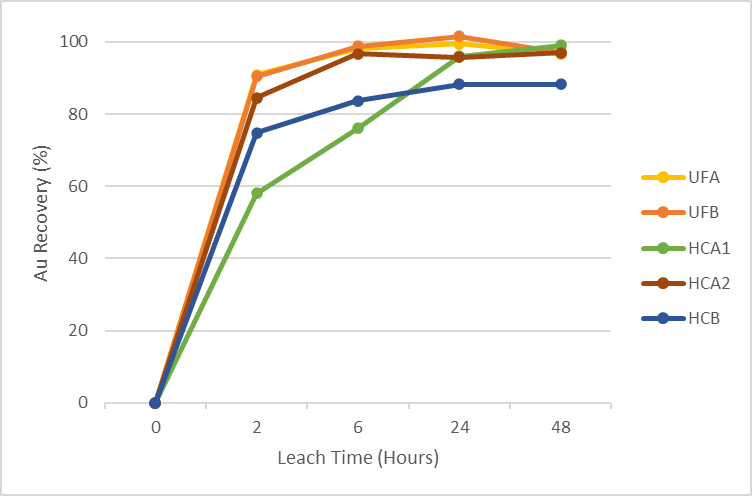 Table 3: 75µm gravity gold concentration
Gravity Au recovery (Table 3) for composites UFA, UFB, HCA1 and HCA2 was low averaging 17.3% with an average gravity concentrate grade of 89 g/t Au. Composite HCB showed good gravity Au recovery of 43.7% with an excellent concentrate grade of 409 g/t Au. Table 4: 75µm flotation
Flotation test work (Table 4) for UFA, UFB, HCA1 and HCA2 returned an average of 71.2% Au recovery and 39.3% S recovery, which suggests flotation may not be the best processing option for Flat oxide mineralization given the high gold recoveries obtained through conventional bottle roll and the combined gravity and bottle roll testing. Composite HCB, which comprised fresh sulphide mineralization, returned 97.4% Au recovery with 76.3% S recovery indicating excellent amenability for gold recovery through flotation of Flat sulphide mineralization. Further test work of the K80 75µm grind comprising gravity concentration followed by bottle roll cyanide extraction of gravity tails was conducted specifically to address the high gravity recovery and lower bottle roll recoveries in composite HCB. Results of the combined gravity - bottle roll tests are summarized in Table 5. Table 5: 75µm gravity + bottle roll
Source : Webdisclosure.com |
||||||||||||||||||||||||||||||||||||||||||||||||||||||||||||||||||||||||||||||||||||||||||||||||||||||||||||||||||||||||||||||||||||||||||||||||||||||||||||||||||||||||||||||||||||||||||||||||||||||||||||||||||||||||||||||||||||||||||||||||||||
Cotations différées d'au moins 15 minutes (Paris, Amsterdam, Bruxelles, Lisbonne).
Cotations à la clôture (Francfort, New-York, Londres, Zurich).
Flux de cotations : Euronext (Places Euronext et Cours des Devises).
Bourse : technologie Cote Boursière