
 WAVESTONE 34.150 € (-1,87 %) SAFRAN 297.600 € (+1,74 %) HERMES INTL 1 387.000 € (+1,06 %)
 ASML HOLDING 1 250.000 € (-6,55 %) CORBION 26.900 € (-0,44 %) CAPGEMINI 130.500 € (+0,77 %) 74SOFTWARE 33.800 € (-1,74 %) SOCIETE GENERALE 64.520 € (+0,99 %) ACCOR 49.480 € (+0,22 %) BIC 65.000 € (+1,40 %) HEINEKEN 84.020 € (+1,01 %) AMUNDI 94.250 € (-0,26 %) SOPRA STERIA GROUP 197.200 € (-0,50 %) STMICROELECTRONICS 37.065 € (-9,34 %) SCHNEIDER ELECTRIC 227.850 € (-1,60 %) PROSUS 38.020 € (+2,77 %) TIKEHAU CAPITAL 16.760 € (-1,18 %) HAFFNER ENERGY 0.587 € (-8,14 %) VEOLIA ENVIRON. 33.750 € (-0,12 %) ING GROEP N.V. 29.225 € (+0,45 %) NANOBIOTIX 27.280 € (+1,49 %) ADYEN 892.500 € (+4,51 %) SWORD GROUP 34.850 € (-0,99 %) AKZO NOBEL 62.580 € (-0,54 %) MAGNUM 17.950 € (-0,33 %) KPN KON 4.451 € (+1,00 %)
 AEGON 7.632 € (+0,13 %) SBM OFFSHORE 32.740 € (-0,67 %)
 DSM FIRMENICH AG 113.300 € (+5,49 %) CVC CAPITAL 14.530 € (-1,76 %) NN GROUP 80.540 € (+0,30 %) ASR NEDERLAND 78.360 € (+0,23 %)
 SHELL PLC 45.440 € (-0,44 %)
 ARCELORMITTAL SA 54.500 € (-1,12 %) AALBERTS NV 41.100 € (-1,77 %) ROCTOOL 1.330 € (-2,92 %) TOTALENERGIES 80.700 € (-1,07 %) CROSSJECT 1.214 € (-0,16 %) HAL TRUST 171.600 € (-0,92 %) 2CRSI 16.220 € (-9,23 %) AIR LIQUIDE 189.720 € (+1,26 %) PHILIPS KON 27.510 € (+0,47 %) GTT 181.800 € (-1,20 %) THALES 224.600 € (-1,27 %) AHOLD DEL 34.640 € (+1,02 %) UNILEVER 60.390 € (+1,05 %) ORANGE 15.340 € (+1,19 %) SOITEC 91.640 € (-16,73 %) HEXAOM 21.000 € (+0,48 %) SAINT GOBAIN 74.440 € (+2,34 %) COVIVIO 45.220 € (-0,75 %) ESSILORLUXOTTICA 191.950 € (+1,51 %) LUMIBIRD 23.050 € (-4,16 %) ARKEMA 58.850 € (+1,73 %) UMG 17.780 € (+1,14 %) Vusion 136.700 € (-5,33 %) WOLTERS KLUWER 92.420 € (+1,38 %) CRCAM LOIRE HTE L. 85.000 € (0,00 %) WERELDHAVE 18.300 € (+0,88 %) CEGEDIM 9.760 € (-0,51 %)
|
14/10/2026 14:10
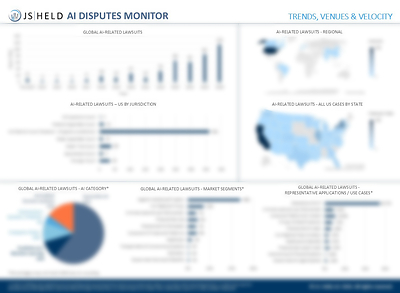
Q3 2026 J.S. Held AI Disputes Monitor Reveals Shift in AI Litigation from How Systems are Built to How They BehaveEQS-News: J.S. Held / Key word(s): Patent/Miscellaneous Forty-two matters added in Q3 broaden scrutiny beyond training data to AI outputs, product safeguards, automated decisions, corporate disclosures, and board oversight. NEW YORK, Oct. 14, 2026 /PRNewswire/ -- Global consulting firm J.S. Held today released the Q3 2026 update to its AI Disputes Monitor. The Office of the Chief Intellectual Property Officer reports adding 42 matters and bringing the tracked dataset to 468 cases, including 115 actions filed in 2026 through September 30. While copyright and training-data disputes remain central, the Q3 additions reflect a broader litigation landscape in which courts are increasingly being asked to examine how AI systems behave after deployment, including their outputs, product safeguards, automated decisions, corporate disclosures, and board oversight.
The Q3 data reinforce a shift already visible during the first half of 2026. Early AI litigation concentrated heavily on the materials used to train models and whether developers had authorization to obtain, copy, or use protected content. Those questions remain active, but the new matters increasingly focus on what happens after an AI system enters the market or is incorporated into business, consumer, and government decision-making. "The litigation is expanding from the inputs used to build AI systems to the consequences of putting those systems into operation," said James E. Malackowski, Chief Intellectual Property Officer at J.S. Held and Co-founder of Ocean Tomo, a part of J.S. Held. "The evidence now may need to explain not only where the data came from, but how the system behaved, what controls were in place, what the organization represented about its capabilities, and how the alleged conduct affected economic value. These questions cannot be separated neatly into technical, financial, and governance workstreams because they often arise from the same underlying facts." From Model Development to Enterprise Accountability The Q3 data does not indicate that copyright or training-data cases are receding. Legal and intellectual property disputes remain the largest individual market segment in the update. Rather, the data show that litigation exposure is expanding across the AI value chain, reaching model developers, technology platforms, companies deploying AI in their operations, public institutions, corporate officers and directors, and users alleged to have circumvented safety controls. This expansion also changes the evidence required to evaluate AI-related claims. A dispute may require examination of model versions, prompts, outputs, system logs, integration records, testing evidence, data provenance, human-review procedures, governance documentation, market impact, and economic loss. J.S. Held's analysis of emerging AI litigation finds that technical causation and economic harm often depend on the same factual record, making coordination among technical, financial, and governance experts increasingly important. "The Q3 matters show that deployment risk is becoming a more coherent part of the AI litigation landscape," said J. Scott Womack, Senior Director in the Office of the Chief Intellectual Property Officer at J.S. Held and head of the AI Disputes Monitor data analysis team. "Across product safety, privacy, automated decisions, securities, and governance, a recurring question is whether the organization can reconstruct how the system operated and demonstrate that appropriate controls were functioning. Policies alone will not answer that question. The relevant evidence may include testing records, system logs, escalation procedures, decision documentation, and proof of meaningful human oversight." Two Forms of AI Disclosure Risk Emerge The Q3 additions also point to two distinct forms of AI-related disclosure risk. The first concerns statements about whether an organization's promoted AI capabilities, integrations, partnerships, or commercial benefits were substantiated. These allegations are commonly associated with "AI washing," in which claims about AI sophistication or value allegedly exceed the supporting evidence. The second concerns whether a company adequately disclosed how AI was disrupting its existing products, pricing models, customer behavior, or growth prospects. In these matters, the allegation is not necessarily that the company's AI capabilities were fictitious. Instead, plaintiffs contend that the organization underrepresented AI's competitive effect on its established business. The distinction is important for directors, officers, investors, insurers, and counsel. AI disclosure risk may arise both from overstating what AI can do and from understating what AI may do to the business. J.S. Held's prior analysis identifies unsupported AI claims as a potential source of corporate credibility, shareholder value, fiduciary, and governance exposure. AI Disputes Require an Integrated Expert Record As AI litigation broadens, the expert inquiry increasingly begins with reconstruction:
AI systems can function simultaneously as technical products, economic assets, and sources of evidence. J.S. Held combines technical investigation, digital forensics, economic damages, intellectual property valuation, governance analysis, and litigation experience to address these interdependent questions. About the J.S. Held AI Disputes Monitor The J.S. Held AI Disputes Monitor tracks AI-related disputes across technology categories, market segments, jurisdictions, and use cases. Drawing on public sources and expert analysis, the Monitor is designed to help law firms, corporate legal departments, insurers, and risk professionals identify emerging litigation patterns, assess developing areas of exposure, and understand the implications for their clients and industries. About J.S. Held J.S. Held is a global consulting firm that combines technical, scientific, financial, and strategic expertise to advise clients seeking to realize value and mitigate risk. Our professionals serve as trusted advisors to organizations facing high stakes matters demanding urgent attention, staunch integrity, proven experience, clear-cut analysis, and an understanding of both tangible and intangible assets. The firm provides a comprehensive suite of services, products, and data that enable clients to navigate complex, contentious, and often catastrophic situations. More than 1,500 professionals serve organizations across six continents, including 84% of the Global 200 Law Firms, 75% of the Forbes Top 20 Insurance Companies (90% of the NAIC Top 50 Property & Casualty Insurers), and 71% of Fortune 100 Companies. J.S. Held, its affiliates and subsidiaries are not certified public accounting firm(s) and do not provide audit, attest, or any other public accounting services. J.S. Held is not a law firm and does not provide legal advice. Securities offered through PM Securities, LLC, d/b/a Phoenix IB or Ocean Tomo Investments, a part of J.S. Held, member FINRA/SIPC. All rights reserved. Contact Kristi L. Stathis | Global Public Relations | +1 786 833 4864 | Kristi.Stathis@jsheld.com
 14.10.2026 CET/CEST Dissemination of a Corporate News, transmitted by EQS News - a service of EQS Group. 2415792 14.10.2026 CET/CEST Source : Webdisclosure.com |
 View original content to download multimedia:
Cotations différées d'au moins 15 minutes (Paris, Amsterdam, Bruxelles, Lisbonne).
Cotations à la clôture (Francfort, New-York, Londres, Zurich).
Flux de cotations : Euronext (Places Euronext et Cours des Devises).
Bourse : technologie Cote Boursière